You Think Your Facility Is Safe. It May Not Be. And You Will Not Know Until It Is Too Late. ↗
The PAC positioning article. Process is not compliance. Activity is not proof.

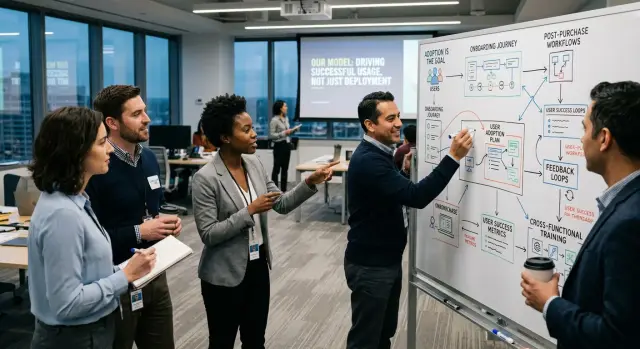
Walk into any large organisation that bought enterprise software in the last five years and ask one question: are you getting the outcome you bought it for?
Most enterprise software fails not because it is bad software - but because buying it and using it correctly are two completely different activities. Here is why we built our entire model around the second one.

Most of the time, the honest answer is no. Not because the software is bad. Not because the team is incompetent. But because buying software and using software correctly are two fundamentally different activities - and most software companies only care about the first.


The dominant model in enterprise software today is sell, scale, reduce cost, reduce human touch. Sign the contract, run an onboarding call, hand over a knowledge base, and move on to the next customer. The goal is to make the product self-service - because self-service scales. Human touch does not. And human touch costs money.
We understand the business logic. But we want to do it differently.
Large organisations are not buying productivity tools. They are buying outcomes - compliance proved, profitability understood, cost reduced. And outcomes do not happen because a product was deployed. Outcomes happen because a product was deployed correctly, used consistently, evolved continuously, and measured against the gap it was supposed to close.
That requires a partner. Not a vendor.
When we engage with a customer, we start not with the product but with the process. What is the current state? Where are the gaps? What does the customer believe their compliance or profitability looks like - and where does reality diverge from that belief?
We run a discovery call. We do a gap analysis. We map our product to those specific gaps. We build a proposal that is customised to this organisation's needs - not a standard pricing sheet with modules ticked off.
Then implementation begins. And this is where most software companies stop showing up. For us, this is where the real work starts.
We track which features are being used and which are not. We go back to the original gap analysis and ask why a feature that was supposed to solve a problem is sitting unused. We audit the deployment every six months - not to criticise, but to correct. We measure what we said we would deliver against what was actually delivered.
And here is a practical reality nobody talks about. People change. The user who was trained leaves. The champion who wanted the product moves on. The context that drove the original decision is lost. Without a partner who maintains continuity - who re-onboards, re-aligns, and re-commits to the outcome - the investment quietly fails. Not with a bang. With silence.
Smaller organisations want a system they can configure quickly and run themselves. That is a legitimate need. It is just not what we are built for.
Large enterprises carry compliance obligations, regulatory exposure, and operational complexity that require more than a deployment. They need someone who understands the full picture and stays with them. For those organisations, the partnership model is not an option - it is the only model that works.
We build software to prove outcomes. Our job is to make that happen - not just at go-live, but every month, every quarter, every year the customer is with us.
When people ask what business we are in, we say enterprise software. But the honest answer is that we are in the outcome delivery business. The software is how we do it. The partnership is why it works.
PUBLISHED BY COGENT · TOUCHPOINT · SYNERGY · ASSET MANAGEMENT
Want to see how we deliver results for enterprise? Take the stress test, book a demo, or see our methodology in action.

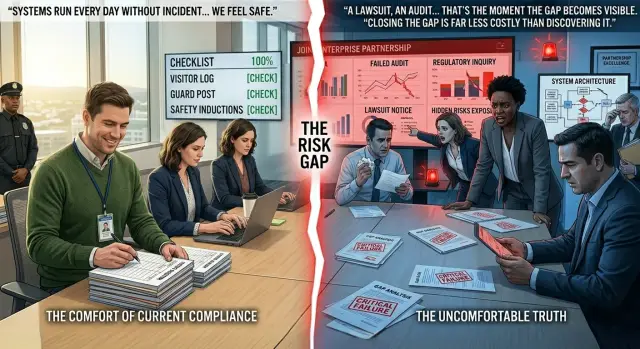
The PAC positioning article. Process is not compliance. Activity is not proof.

The vulnerability score article. Introduces the stress test as a concept.