Give Us 10 Transactions From Your Facility. We Will Show You Where You Are Vulnerable. ↗
The vulnerability score article. Introduces the stress test as a concept.

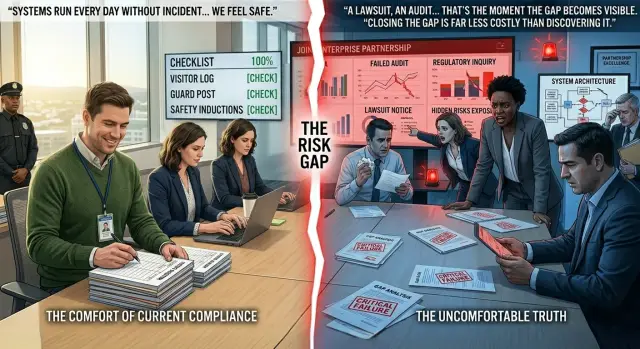
Every facility head we speak to believes their facility is under control.
They have a visitor register. They have a guard. They issue passes. They run safety inductions. The system runs every day without incident. So they feel safe. They feel protected. They feel compliant.
Most of them are not.
And the uncomfortable truth is this - they will not find out until something goes wrong. An audit. An incident. A regulatory inspection. A lawsuit. That is the moment the gap becomes visible. By then, the cost of discovering it is far higher than the cost of closing it.
Walk through any enterprise facility on a typical day. Visitors sign in. IDs are collected. Passes are printed. Guards are posted. Contractors show their documents. Materials come in and go out. Everything appears to be running smoothly.
But appearing to be under control and being provably under control are two completely different things.
A visitor register records that someone arrived. It does not prove they were pre-authorised. It does not prove they completed a safety induction. It does not prove they stayed within their permitted zone. It does not prove they left when they were supposed to. It is a record of a transaction - not proof of compliance.
A gate pass records that material moved. It does not prove the movement was authorised before it happened. It does not prove the quantity matched the purchase order. It does not prove returnable items came back.
A contractor induction records that someone went through onboarding. It does not prove their documents are valid today - three months later. It does not prove their safety certification has not quietly expired while they have been walking into your facility every morning.
This is the gap. Not between having a system and not having one. Between recording activity and proving compliance.
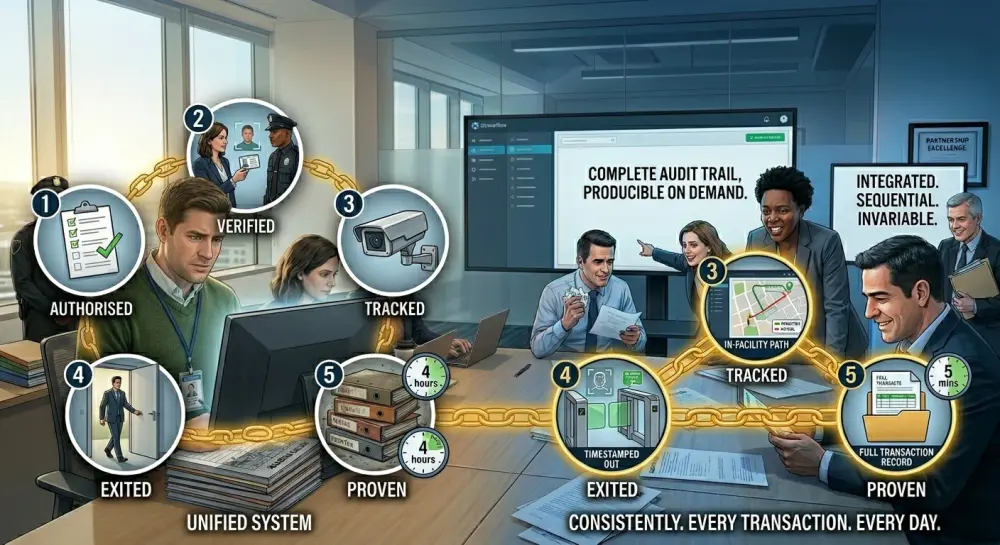
To bridge this gap, you need to move from tracking to governance. You need a platform that doesn't just record what happened, but enforces what SHOULD happen.
The gap exists because most facility management software was built to record transactions - not to enforce compliance. And the gap stays invisible for one simple reason: nothing has gone wrong yet.
When a contractor with an expired certificate enters your facility every day for six months without incident, the gap does not announce itself. When a visitor wanders into a restricted zone because zone access was never enforced, nothing happens - until it does. The feedback mechanism only activates at the point of failure.
That is what makes this genuinely difficult. The facility that has been running a smooth process for three years has no signal that anything is wrong. The system appears to be working. Until it is not.
Physical access compliance is not one thing. It is five - in sequence, every time, for every transaction.
Most facilities achieve one or two of these. Very few achieve all five - consistently, for every transaction, every day.
Can you confirm, right now, that every person inside your facility is authorised to be there - not just badged in, but verified and within their permitted zone?
Can you produce a complete access trail for your facility for last Tuesday - every visitor, contractor, and material movement - within 30 minutes?
If an incident occurred an hour ago, could you prove with timestamped records that every compliance obligation was met?
If the honest answer to any of these is no - or not sure - the gap is open right now. Not a process gap. A compliance gap.
The organisations that have made this shift share one habit. They stopped asking “did we follow the process?” and started asking “can we prove the outcome?”
The difference sounds small. In practice it changes everything. When the question is proof - not process - a register is not enough. A signature is not enough. An induction session is not enough. What is required is a timestamped, auditable, producible record that answers every question before it is asked.
That shift separates a facility that is managed from one that is truly compliant.
Not with a new system. With an honest assessment.
Take those three questions above and answer them without optimism. Most facility heads who do this discover they are further from compliance than they believed. That is uncomfortable. It is also the most valuable thing they can learn - because it tells them exactly where the gap is and what it takes to close it.
The gap between recording activity and proving compliance is not a large one. But it is a consequential one. And it is worth closing before the auditor arrives - not after.
PUBLISHED BY COGENT - BUILDERS OF TOUCHPOINT, THE PHYSICAL ACCESS COMPLIANCE PLATFORM.
Want to know where your facility stands? Take the stress test - three questions, 30 seconds, an instant vulnerability score.


The vulnerability score article. Introduces the stress test as a concept.

Why enterprise software fails and how our partnership model delivers actual outcomes.