You Think Your Facility Is Safe. It May Not Be. And You Will Not Know Until It Is Too Late. ↗
The PAC positioning article. Process is not compliance. Activity is not proof.


Most facility heads are confident their operations are under control.
Not overconfident. Just quietly confident. The system is running. Nobody has raised a flag. The last audit went smoothly. So when someone suggests there may be gaps in their facility's access control, the natural response is - where exactly?
Fair question. Here is our answer.
Give us 10 transactions from your facility. Any 10. A visitor entry from last week. A material gate pass from yesterday. A contractor who has been coming in for the past month. We will look at each one against a simple compliance standard - and we will show you where the vulnerability is.
We have never done this exercise with a facility and found nothing.
A transaction is any event at your gate. A person entering. A material moving. A vehicle arriving. A contractor checking in. Your facility generates hundreds of these every day. Most of them are recorded somewhere - in a register, in a system, in a spreadsheet.
What we are asking is not whether they are recorded. We are asking whether they are compliant.
These are different questions. And most facilities have never asked the second one.
Pick any visitor who came to your facility last week. Now answer these honestly.
Five questions. One visitor. How many can you answer with documented evidence - not memory, not assumption, but a record you can pull up right now?
For most facilities, the honest answer is one or two. The visitor was logged. That is all.
Pick any outward gate pass from this week. Now answer these.
Again, five questions. One gate pass. Most facilities can answer the first one - sometimes. The rest are gaps.
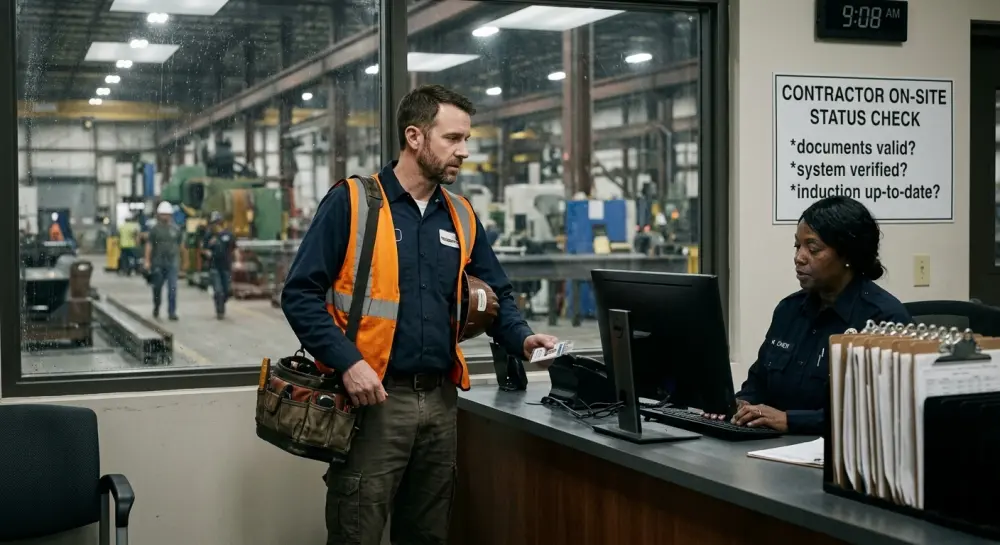
Pick any contractor who walked into your facility this morning. Now answer these.
One contractor. Walking into your facility right now. And for most organisations, the honest answer to the last question is no.
We are not describing extreme scenarios. We are describing ordinary Tuesday morning transactions at large, well-run facilities with real compliance intentions.
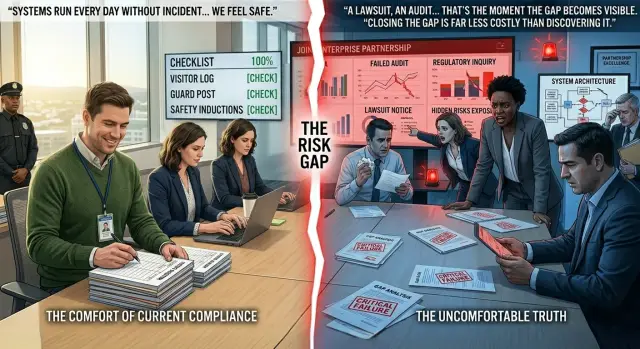
The vulnerability is not that facilities are careless. It is that the gap between recording a transaction and proving compliance is invisible in normal operations - and only becomes visible at the worst possible moment.
An audit. An incident. A regulatory inspection. A legal dispute.
By then, the question is no longer "where is the gap?" The question is "how much does the gap cost?"
This is what we call the stress test. Not a product demo. Not a sales conversation. A diagnostic.
Take any 10 real transactions from your facility - visitors, materials, contractors, in any combination - and run them against the five compliance questions above. Count how many you can answer fully, with documented evidence, right now.
If the number is 10 out of 10 - you are genuinely in good shape.
If the number is anything less - you now know exactly where your vulnerability is. And more importantly, you know what closing it actually requires.
Most facility heads who run this test are surprised. Not because their operations are poorly run - but because they have never asked this specific question before. The difference between a managed facility and a compliant one turns out to be narrower than they expected. And far more consequential.
PUBLISHED BY COGENT - BUILDERS OF TOUCHPOINT, THE PHYSICAL ACCESS COMPLIANCE PLATFORM.
Ready to run the stress test on your own facility? Three questions. 30 seconds. Your vulnerability score - instantly.

The PAC positioning article. Process is not compliance. Activity is not proof.

Why enterprise software fails and how our partnership model delivers actual outcomes.